

Perché l'accoppiamento idraulico è la soluzione ideale per i nastri trasportatori per carichi pesanti
2026-04-17 11:21Perché scegliere Dalian Mairuisheng per il vostro sistema di trasporto?Accoppiamento fluidoEsigenze?
In qualità di produttore specializzato di apparecchiature per la trasmissione idraulica con oltre 15 anni di esperienza, Dalian Mairuisheng offre una gamma completa diAccoppiamento fluidoprodotti per applicazioni di nastri trasportatori. La nostra serie YOX a riempimento costanteAccoppiamenti idrodinamiciCopriamo potenze che vanno da frazioni di kW a oltre 1.000 kW, con dimensioni da 274 a 1150. Offriamo anche modelli a doppia camera, unità con disco freno integrato e design con puleggia integrata per esigenze di configurazione specifiche.
OgniAccoppiamentoI nostri prodotti sono fabbricati nel nostro stabilimento certificato ISO 9001, con tracciabilità completa dei materiali e test delle prestazioni prima della spedizione. Il nostro team di ingegneri fornisce un'analisi del carico pre-vendita gratuita: è sufficiente fornire la potenza del motore, la lunghezza del nastro trasportatore, la frequenza di avviamento e l'ambiente operativo e vi consiglieremo la soluzione ottimale.Accoppiamento fluidoModello per la vostra applicazione. Dimensioni di montaggio personalizzate, interfacce per alberi e materiali speciali sono disponibili su richiesta.ConclusionePer i nastri trasportatori per carichi pesanti, la scelta di
Accoppiamento
ha un impatto diretto sull'affidabilità delle apparecchiature, sui costi operativi e sulla sicurezza. Una scelta appropriataAccoppiamento fluidooffre avviamenti fluidi e senza scosse, protezione intrinseca contro i sovraccarichi, ripartizione automatica del carico e lunga durata in ambienti difficili. Sia che si tratti di specificare un nuovo sistema di trasporto o di ammodernare uno esistente, unaccoppiamento idrodinamicoDa Dalian Mairuisheng è la soluzione ideale.Hydrodynamic coupling allows the motor to accelerate to near full speed under no load before gradually applying torque to the conveyor.
The working principle is elegantly simple. A Fluid coupling consists of a pump wheel (connected to the motor), a turbine wheel (connected to the driven machine), and a working chamber filled with hydraulic fluid. As the motor spins the pump wheel, centrifugal force accelerates the fluid, which then strikes the turbine blades, transferring torque. Because there is no direct mechanical connection between input and output, the Coupling inherently absorbs shock and dampens torsional vibrations. This fundamental characteristic makes the Fluid coupling ideal for applications where smooth acceleration is critical.
Key Insight: A Fluid coupling transforms starting current spikes into a smooth, controlled torque ramp, eliminating the mechanical shock that tears conveyor belts and damages gearboxes.
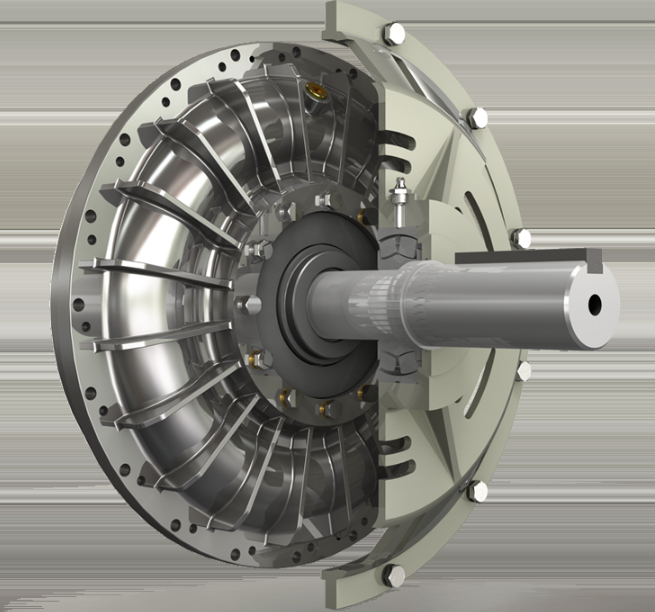
Soft Start: Eliminating Mechanical Shock
For long belt conveyors, the most damaging event is not continuous operation — it is startup. A sudden jolt can cause belt splice failure, pulley misalignment, and gear tooth fracture. Hydrodynamic couplings address this through their inherent soft-start characteristics. As the pump wheel rotates, the fluid takes time to accelerate the turbine, creating a natural torque ramp that can be tailored to the specific application. For medium and long conveyors requiring startup times up to 45 seconds, constant-fill Fluid coupling designs are particularly well-suited.
The performance impact is substantial. In one case study at a mining facility in Xinjiang, replacing a rigid Coupling with a Dalian Mairuisheng Fluid coupling (Model 422TVB) achieved a 95% reduction in startup shock loads. Component lifespan extended by 40%, and unplanned downtime was eliminated entirely. The Fluid coupling enabled smooth acceleration and inherent overload protection, reducing annual maintenance costs by 30%. The same mine had previously experienced monthly belt splice failures and gearbox input pinion fractures — problems that disappeared after the Hydrodynamic coupling was installed.
Overload Protection: The Built-In Safety Buffer
Belt conveyors are vulnerable to sudden overloads — material surges, jams at transfer points, or blockages in chutes. A rigid Coupling transmits these overloads directly to the motor and gearbox, often causing catastrophic failure. In contrast, a Fluid coupling acts as a built-in torque limiter. When the driven machine jams or faces excessive load, the Coupling allows the motor to continue running without stalling, as fluid slip limits torque transmission. This prevents motor burnout and avoids costly repairs. In mining operations, Fluid couplings protect conveyor belts from overload-induced tears, ensuring uninterrupted production.
For multi-motor drive systems — common on very long conveyors — Hydrodynamic couplings also provide automatic load sharing. If one motor tries to take a disproportionate share of the load, its Coupling will slip slightly, naturally balancing torque across all drive units. This sequential starting capability reduces the load on the supply circuit, avoiding grid overloading caused by simultaneous motor starts.
Energy Efficiency: Reducing Operating Costs
Beyond protection, Fluid coupling technology delivers measurable energy savings. By allowing motors to start under light load, a Hydrodynamic coupling cuts power consumption and minimizes grid stress. In pump or fan applications, Fluid couplings facilitate speed adjustment without motor throttling, leading to significant energy conservation — up to 30% in some cases. For belt conveyors, the reduction in peak current draw during startup translates directly into lower electricity demand charges and reduced mechanical stress on electrical components. An analysis of belt conveyor drives related to energy efficiency shows that the use of such devices leads to energy savings of up to 20%.
The efficiency of a Fluid coupling at full load is also excellent, with typical slip ranging from 2-5% depending on application and size. For a conveyor system running 24/7, this minimal slip represents a small fraction of total power consumption — easily offset by the dramatic reduction in maintenance and downtime costs.
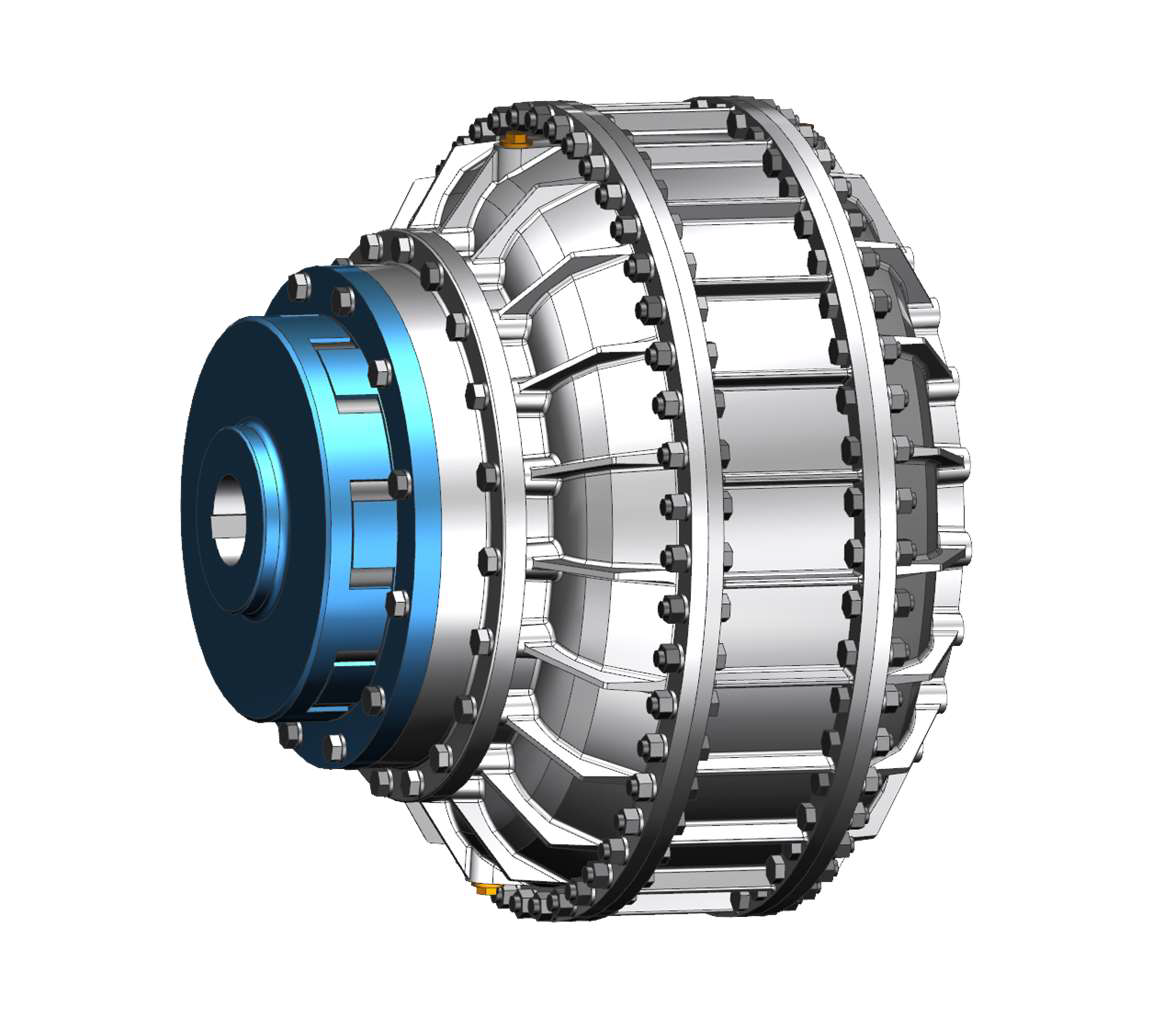
Dual-Chamber Fluid Coupling: Built-In Redundancy for Critical Operations
For mission-critical conveyor systems where a single point of failure is unacceptable, Dalian Mairuisheng offers dual-chamber Hydrodynamic coupling designs. These units integrate two independent working chambers within a single housing. If one chamber fails (e.g., seal leakage), the other chamber can still provide partial torque transmission and buffering, allowing the conveyor to continue operating until scheduled maintenance. This redundancy is particularly valuable for mainline conveyors in underground mines or ports where unplanned downtime carries enormous financial penalties. The parallel-acting circuits of dual-chamber Hydrodynamic couplings also double the power transmission capacity within the same envelope, offering higher power density.
High-Temperature and Harsh Environment Performance
Mine conveyors often operate in extreme conditions: high ambient temperatures, dust, humidity, or even explosive atmospheres. A well-designed Fluid coupling is inherently robust. With no mechanical contact between input and output, Hydrodynamic couplings experience minimal wear and require little upkeep beyond periodic oil checks. They can be supplied with high-temperature resistant seals, special alloys, and even water as the operating medium for applications in potentially explosive atmospheres The TVVS Fluid coupling can use water as the operating medium, an environmentally-friendly solution particularly well-suited for conveyors transporting ore near water bodies.
For customers operating in extreme climates, Dalian Mairuisheng provides customized Coupling solutions with low-temperature fluids and specialized materials, ensuring reliable startup even at -40°C. With proper specification, a Hydrodynamic coupling will perform reliably for years without major overhaul, as demonstrated by installations at the Tanjung Enim Coal Mine where Fluid couplings installed more than 17 years ago continue to operate on 13 existing belt conveyors.
Why Dalian Mairuisheng for Your Conveyor Fluid Coupling Needs?
As a specialized manufacturer of hydraulic transmission equipment with over 15 years of experience, Dalian Mairuisheng offers a comprehensive range of Fluid coupling products for belt conveyor applications. Our YOX series constant-fill Hydrodynamic couplings cover power ranges from fractional to over 1,000 kW, with sizes from 274 to 1150. We also offer dual-chamber models, brake disc-integrated units, and pulley-integrated designs for specific layout requirements.
Every Coupling we produce is manufactured in our ISO 9001-certified facility, with full material traceability and performance testing before shipment. Our engineering team provides free pre-sales load analysis — simply provide your motor power, conveyor length, starting frequency, and operating environment, and we will recommend the optimal Fluid coupling model for your application. Custom mounting dimensions, shaft interfaces, and special materials are available on request.
Conclusion
For heavy-duty belt conveyors, the choice of Coupling directly impacts equipment reliability, operating costs, and safety. A properly selected Fluid coupling delivers smooth, shock-free starts, inherent overload protection, automatic load sharing, and long service life in harsh environments. Whether you are specifying a new conveyor system or retrofitting an existing one, a Hydrodynamic coupling from Dalian Mairuisheng is the ideal solution.